Wednesday, December 9, 2009

DATO SRI EDMUND LANGGU ANAK SAGA


Dato Sri Edmund Langgu Anak Saga, 74 was born at Rumah Ulak, Sungai Kelampai in the Saratok land district. He is a descendant of Orang Kaya Beti from Padeh, Betong, Sarawak. He joined the Batu Lintang Teacher’s Training College in Kuching and latee taughts for several years. Before Malaysia was formed in 1963, he decided to enter the political arena and was being elected as a district councillor and the divisional Advisory Councillor with the Second Division of Sarawak.
During the general election, he was elected as the Member of Parliarment for Saratok - a seat that he held for a period of almost twenty five years. He also held several portfolios over the last four decades as a Deputy Federal Minister and as well as a Malaysian National Opposition leader. He was also the assemblyman for Krian constituency for the period of two five year terms.
He has held several important positions in two political parties as a secretary-general and a vice president for both the Sarawak National Party (SNAP) and Parti Bansa Dayak Sarawak (PBDS).
Dato Sri Edmund Langgu also held other posts, including as a Chairman of The Malaysian Pepper Marketing Board, Chairman of The Commercial Vehicle Licensing Board of Sarawak, as a Member of The Malaysian Public Accounts Committee, Sarawak, Brooke Dockyard Board and Kuala Lumpur Stock Exchange.
Currently Dato Sri Edmund Langgu is a consultant with The Tun Jugah Foundation, where he is as an editor and contributor on research and studies on Iban language, culture and tradition. He is also a chariman of a new comprehensive Iban dictionary, scheduled for publication by the Foundation sometime in the near future. With his deep Knowledge of and personnel experience in the Iban culture, history, song, proverbs, law, language and tradition, he has been invited to give talks and is a regular speaker on Radio Malaysia Sarawak.

JAMES RITCHIE


James Ritchie, 60, ia a journalist of 35 tears. He was recruited as a cadet reporter by the New Strait Times in 1972 and he worked as a sports reporter before joining the NST Crime Desk in Kuala Lumpur. After a two year stint as the Seremban correspondent he was transferred to Kuching as NSTs correspondent. During his 28 years on Sarawak, Ritchie has written numerous stories, articles and special reports on local affaiers.
He later joined the Sarawak Chief Minister’s Department as a Public Relation Officer, the Borneo Post as a media consultant and at various times worked for the Sarawak Tribune, Borneo Post, The Star and Eastern Times.
Ritchie has a penchant for writing about politics, famous Sarawak personalities and historical figures. He has authored several books including Bruno Manser: The Inside Story, A Gentleman’s victory for Taib Mahmud, A political Saga, Sarawak Awakens – Politics Of Development, Changes and Challenges 1998, Life Story of Temenggong Koh, Honour Before Self, Tun Ahmad Zaidi – Son Of Sarawak, Man Eating Crocodiles of Borneo, Abdul Taib Mahmud – 41 Years in News, Who Gives a Dam – The Bakun Odysey, Limbang – the Crown Jewel of Sarawak and Temenggong Oyong Lawai Jau – A Paramount Chief of The Baram.

LIBAU RENTAP FAMILY TREE

Tuesday, December 8, 2009

END OF RENTAP’S POWER

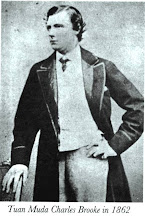
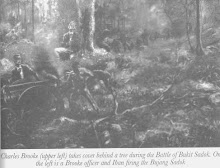
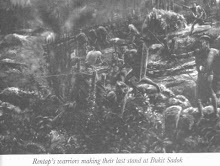
When Libau RENTAP realised that it was useless for him to defend the fortress of Bukit Sadok any longer, he commanded his war men to leave it from the opposite side of the mountain. Now the attacking party of Tuan Muda Charles Brooke under cover of the musket shot, rushed over the neck of the rock and entered the fortress through the holes made by the shots from “Bujang Sadok”.
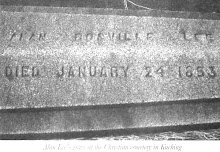
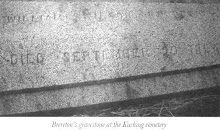
They found that Libau RENTAP and his war men had escaped except for the dead and dying. Inside the fortress they also found the arms captured by Libau RENTAP when he fought against Alan Lee and William Brereton at Lintang Batang stockade in 1853. A large quantity of gun powder and the famous one armed iron cannon named the “Bujang Timpang Berang”. That afternoon the Sarawak Government Forces attacking party burnt down Libau RENTAP fortress at Bukit Sadok. A guns was fired and in ten minutes a tongue of flame shot up into the sky with thick black smokes. At dusk the summit of Bukit Sadok was seen burning for miles and miles away. It marked the end of Libau RENTAP’s power over the White Rajah’s and his long career as a great Dayak Iban war leader where he got the title of Raja Ulu, but he won’t surrender his life to the White Rajah’s.
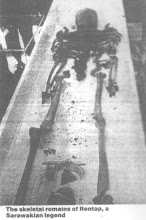
Libau RENTAP and his war men did not surrender but retreated to Bukit Lanjak Entimau at the headwaters of Batang Skrang, Lemanak and Engkari. He then moved down to the Ulu Entabai the branch of Kanowit and Julau and made another fortress at Bukit Setulak. At his old ages he moved to Karangan Panggil in Ulu Wak, Pakan and died at old ages in the year 1870. He was not buried, but his remains was kept according to the symbol of the Dayak Iban warrior, but honourably laid down to rest in peace in a mortuary known by the Dayak Iban as “Lumbong”.
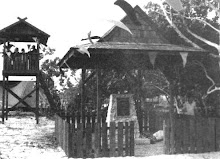
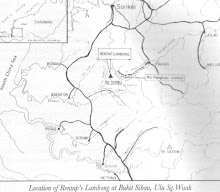
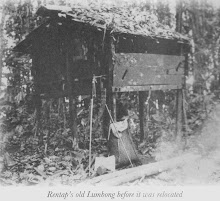
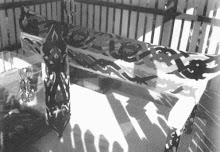
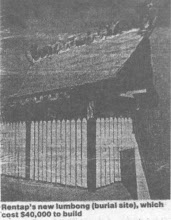
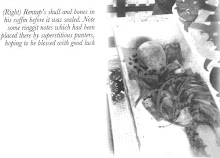
His tomb, the “Lumbong” is still intact today located at the summit of Bukit Sibau at the headwaters of Budu/Kabo River of Saratok and Wak River of Pakan. His remains was before kept in a large ceramic jar but it was later placed inside a coffin after the reburial of his remains was done in October, 1989 which was done by the Sarawak State Government in the Dayak Iban traditional heroes burial ceremony named Gawai Ngelombong.
Libau RENTAP’s principal enemy, Sir James Brooke the first White Rajah of Sarawak was born in India on 29th.april, 1803. he was proclaimed the Rajah of Sarawak on 24th.September, 1841 and retired due to ill health in 1863, about two years later after the defeat of Libau RENTAP at Bukit Sadok on 25th.October,1861. He died at Burrator, England on 11th.June,1868 at the age of sixty five and buried at Sheepstor Churchyard.
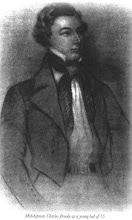
Another principal enemy of Libau RENTAP’s was Sir Charles Brooke, the Second White Rajah of Sarawak who was born on 3rd.June,1829 at Berrow Vicarage near Burnham, Somersethire, England. He was proclaimed Rajah in place of his uncle Sir James Brooke on 3rd.August,1868. he died on 17th.May,1917 at ther age of eighty eight and was buried beside the tomb of his uncle, Sir James Brooke.
Nanang who plaed a key role at the time of the final Sadok War Expedition on 28th.October,1861 received his father’s title of “Orang Kaya Pemancha” from the Second White Rajah, Sir Charles Brookeat a ceremony at Fort Alice at Simanggang (now known as Sri Aman) in 1882. he served the Government Of Sarawak as a member of the Supreme Council representing the people of Upper Saribas until his death in 1901. he was succeeded by his son, Penghulu Insoll of Buloh Antu, Padeh until 1912.
Libau RENTAP was a man of principal. He swore that he would never see the face of a White Man again in his life. He met several defeats but never surrendered. He had been branded as a great rebelious Dayak Iban War Leader, hunted high and low and yet he manged to live until he met his natural death during the period of his retirement from active war fighting. He fought gallantly defending his country land and his people from several attacks made by the intruders until his whole power was broken on 28th.October,1861 but not his life.
His name is still mentioned and remembered today as a great Dayak Iban Chief and Dayak Iban War Leader and aslo the the Hero Of Bukit Sadok in the history of Sarawak and Malaysia.

THE THIRD BUKIT SADOK WAR EXPEDITION IN THE YEAR 1861

After the death of their famous brother Aji Apai Limpa, the other two well known brothers named Nanang and Luyoh, the sons of Orang Kaya Pemancha Dana Bayang strongly supported Libau RENTAP. They built a stockade at another ridge below the fortress of Libau RENTAP’s at Bukit Sadok.
According to the written record, Libau RENTAP had descended from his strong hold on the Bukit Sadok and he carried off a young girl and made her the Rani of Bukit Sadok.
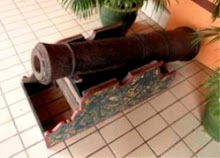
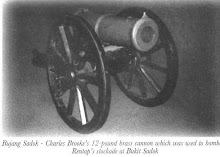
It was resolved in September, 1861 that the Sarawak Government Forces under the command of Tuan Muda Charles Brooke should finally attack Bukit Sadok for the third time. Thus on 16th.October,1861 the war expedition was ready to go up the Batang Saribas and destroy Libau RENTAP. In addition to the usual party of the Malays and the Dayaks there were also some twenty Chinese labourers to make their paths through the thick jungle and to carry a large twelve pounder brass cannon specially cast for the ocassion in Kuching. The cannon was given the name of “Bujang Sadok”. It is still on display at the Police Museum in the Fort Margherita in Kuching.
On the 20th.October,1861 the Sarawak Government Forces led by the Tuan Muda Charles Brooke sent two messengers (seruan), named Jabu and Ngadan of Bangat, Betong to summon Nanang and Luyoh to a meeting which led to their submission. Their submission was accepted by Tuan Muda Charles Brooke on condition that they would pay a fine of forty valuable ceramic jars named “Tajau Rusa”. The ceramic jars were retained by the Government of Sarawak at Skrang Fort for three years. Nanang and Luyoh kept their promises and remained loyal to the rule of the White Rajah. Eventually the ceramic jars were returned to them after that.
When Libau RENTAP heard about the two brothers of Nanang and Luyoh had surrendered without consulting him first , he was very angry and sent down a party of his men to burnt down their longhouses which was closed to his fortress at the Bukit Sadok.
The Tuan Muda Charles Brooke detailed sixty men to carry the twelve pounder brass canon named “Bujang Sadok” up the mountain of Bukit Sadok It took them four hours to reach the summit of Bukit Sadok, fortunately Libau RENTAP did not attack them on their way.
At half past four in the morning of 28th.October,1861 the “Bujang Sadok” was placed in position ready for action to destroy Libau RENTAP. But due to a dense mist at that early hours the cannon could not be used. When the mist was cleared away after half past seven, a strong wind came and rendered the rocket useless. Later on “Bujang Sadok” was put into action but after the seventeenth round , the carriage gave way. However, it had done part of its duty in tearing away certain parts of the stockade of the Libau RENTAP Bukit Sadok fortress.
Libau RENTAP returned the fire with famous one armed iron cannon named “Bujang Timpang Berang” which was formerly belonging to Orang Kaya Pemancha Dana Bayang, the father of Nanang and Luyoh. According to the story , Libau RENTAP’s gunner was killed by a shot from “Bujang Sadok”. His blood soaked the gunpowder which put “Bujang Timpang Berang” out of action.

Wednesday, November 25, 2009

THE SECOND BUKIT SADOK WAR EXPEDITION IN THE YEAR 1858

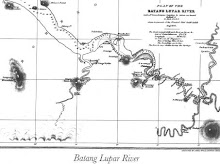
After the death of Dayak Iban Warrior named Aji Apai Limpa, the large group of the Sarawak Forces erected a small stockde at Nanga Sungai Langit. From Nanga Sungai Langit they pushed on to the Nanga Tiga at the Upper Layar River. Nanga Tiga meant the three river mounth, which one of it flows from the Bukit Sadok, one from the watershed where rises the Kanowit River and Julau River, and the third main the Layar River.
Here the Sarawak Forces left their long paddle war boats and erected a stout stockade. Then they moved advanced up-country with Tuan Muda Charles Brooke who was in command of this second Bukit Sadok War Expedition in the year 1858 to defeat and capture the strong and bravest Dayak Iban War Leader Libau RENTAP. From Nanga Tiga they proceeded to Ulu Julau to attack Mujah “Buah Raya”. Here they defeated Mujah “Buah Raya” and they burnt their longhouses and destroyed the surrounding padi fields belonging to the Ibans. It was indeed a barbarious act by the Sarawak Forces. Women and childrens suffered greatly due to the loss of their homes and padi fields, and also their staple food.
After the return of the ravaging party , the Sarawak Forces marched toward Bukit Sadok. In this expedition they carried along a small mortar with them up the mountain. After half past ten in the morning they reached the summit of Bukit Sadok. Libau RENTAP and his war men were ready to defend themselves against the attack. The attacking party had erected a small stockade within firing distance from the Libau RENTAP fort. They fired fifty rounds of shell which made a little effect on the well fortified fort. Libau RENTAP had not returned the fire, and the place seemed to be deserted.
Then some of the Tuan Muda Charles Brooke men have already moved very close to the stockade and then Libau RENTAP and his war men opened fire on them. The Libau RENTAP stockade was too strong for them to attack. Then some of the war chiefs on the Tuan Muda Charles Brooke side begged him to stop attacking Libau RENTAP, saying “We cannot pull down the planks with our own hands, we cannot climb over them and our small gun and musket shots make no effect on them.” Thus they decided to abandon the attack. The retreat began at once. This made Libau RENTAP felt more hilarious and he mocked them by saying “Bring all your fire guns from England and we are not afraid of you.” He and his men threatened and followed the retreating party down the hill with the discharge of guns, spears and poison arrows.
Thus ended the Second Bukit Sadok War Expedition. It was again a total failure on the part of the White Man. Their mortar seemed useless as it could not penetrate and destroy Libau RENTAP’s fortress which was impregnable. He won the battle and the White Man made no further attempts on his fortress until the year 1861.

Monday, November 16, 2009

THE HISTORY OF AJI APAI LIMPA

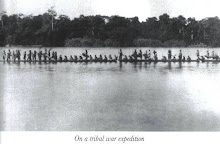
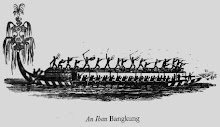
It was reported to the Tuan Muda Charles Brooke in Skrang in April 1858 that Aji Apai Limpa, the second son of Orang Kaya Pemancha Dana and his supporters, Lintong Moahari a Julau Chief with a fleet of forty bangkong (Iban long paddle warboats) were ready to go down the Batang Saribas to raid the coastal areas.
When Tuan Muda charles Brooke heard the news he called for the aid from Kuching. In the meant time, he left Skrang in his big boat with sixty men and a three-pounder gun in her bows. While arriving at Lingga he found that the small gun boat named Jolly Bachelor, command by John Channon was waiting for him there. They went up the Saribas with a picked crew and several native bangkong was following behind.
They went as far as Nanga Padeh near the longhouse of Aji Apai Limpa longhouse and his brother , Nanang. From there they attacked Aji’s longhouse. His fort (Kuta) was not strong enough, and he lost a number of fighting men and their long houses were destroyed. Fortunately for Aji Apai Limpa , cholera had spread in the area, and this forced the attacking party of Tuan Muda Charles Brooke to retreat.
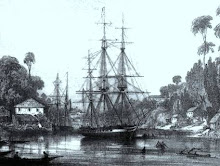
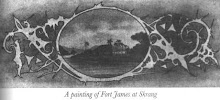
Tuan Muda Charles Brooke decided to construct a fort (Kubu) at a commanding position on the bank of the Saribas River. The fort was soon built at a place originally known as Rantau Anak which is now called Betong. The Saribas fort was later named as Fort Lily. A young god-son of Rajah James Brooke by the name of James Brooke Cruickshank was put in charge of the new station.
Fort Lily which was constructed in the year 1858 is the oldest fort built in Sarawak. It had been rebulit many times through the years and it have been used as the administrative headquaters of the Saribas District in Betong before. Leaving James brooke Cruickshank in charge of the new fort, the Tuan Muda Charles Brooke returned to the Skrang District. He then heard that Linggir Mali Lebu was leading a war expedition (Ngayau) to raid the Malays villages in the coastal areas. He immediately sent orders for the Balau Ibans to ambush them at Meludam. During the battle Linggir Mali Lebu lost fourteen men and he himself was wounded. Thus he had a narrow escape to safe himself.
In retaliation to the attack on their longhouses, Aji Apai Limpa and Lintong Moahari led a full forces of his war men on 14th.July,1858 with the mission to destroying the Fort Lily at Betong.
But James Brooke Cruickshank aided by Panglima Bakir and his warriors managed to drive them back. Before the end of 1858 the Tuan Muda Charles Brooke once again organised a big scale war expedition against Aji Apai Limpa and his allies in retaliation to the attack on the Fort Lily. The Tuan Besar Captain Brooke Brooke who commanded this war expedition led the advance party from Kuching, while the Tuan Muda Charles Brooke led the main war men which comprising 200 Malays and 2,000 Dayaks to fight for them in the war.
When Aji Apai Limpa saw that a large enemy forces was advancing paddling their long war boat up the Sungai Layar, he ordered his men to fell a large trees standing low on the river banks so as to fall across and block the passage on the Sungai Layar. This barrier had been done for several mile along the Layar River. Aji Apai Limpa did not form them into pengerebah (blockade), but left all the trees to lie anywhere they felt in the river. (Pengerebah is a method employed by the Dayak Ibans to hinder the progress of an enemy to paddled their long war boat up the river. The trees inclining to the river are cut to breaking point, and sustained by means of rotans. Within a moment the rotans can be cut and the trees will fall and crush the enemy while they were passing by in their long war boats.)
Despite the obstruction the Tuan Muda Charles Brooke war men managed to proceed themselves upstream, but with many difficulties, and after a few days of hard works, they reached the Sungai Langit. Here the Dayak Ibans under the command of Aji Apai Limpa attacked the Tuan Muda Charles Brooke war men named the Sarawak forces. Heavy war battle took place, and during the engagement Aji Apai Limpa gallantly dashed forward to attacked the enemies with his single handed.
Unfortunately he was struck down by a musket shot. Some said that he was wounded by the shot but died from the impact of the bullet. Others said he was strangled to death because he was known to be invulnerable. He used to boast that the White Man’s gunpowder and shots would make no effect on his body. Nevertheless, his end had come.
That was the end of one of the most gallant Dayak Iban war leaders of the Saribas . He died honourably while defending his homeland and peoples against the intruders. He had performed many brave deeds against his principal enemy, the White Man. In memory of his many wonderful deeds and bravery in the battles the Ibans still mention and praise his name in their cultural songs and chants today as “Baka Pemerani Aji Apai Limpa Nan Ka Kuta Ngelaban Raja Di Nanga Sungai Langit.” Which meant “As brave as Aji Apai Limpa who defended his fort against the Rajah war men at the Nanga Sungai Langit.”
Nanang and Luyoh were enraged at the death of their brother , Aji Apai Limpa. They collected as many men as they could and supported Libau RENTAP on the fort of Bukit Sadok. They built another fort next to Libau RENTAP. They wanted to avenge the death of their brother, Aji Apai Limpa, who had distinguished himself gallantly as a war leader in defending his homeland and people and never surrendered to the rule of the White Rajah. He is thus a great Dayak Iban War Hero.